
Topteaser
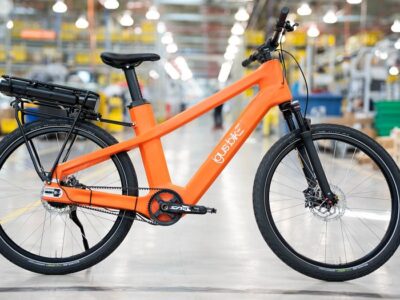
igus continues to drive forward the vision of sustainable urban mobility. At the Eurobike trade show, the company is presenting an electric version of its igus:bike for the first time, responding to the growing demand for low-maintenance e-mobility in cities. The previous model has already proven its robustness on a 1.5-year world tour in wind and weather. The tried-and-tested plastic bicycle has been continuously enhanced and forms the basis for the new electric bicycle. Like the igus:bike, it consists of 50 per cent recycled fishing nets and offers people the opportunity to combine environmental protection with low-maintenance urban mobility. And all this at a reasonable price of €2,500.
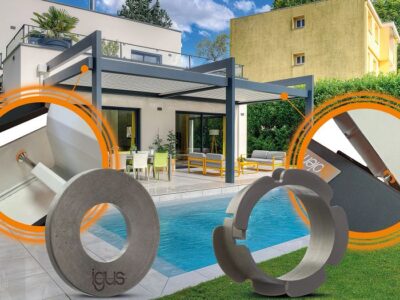
Keeping service costs low in times of shortages of skilled personnel: Sunilux, the French manufacturer of bioclimatic pergolas, achieves this by using lubrication-free and maintenance-free polymer bearings from igus. The company can offer an above-average ten-year guarantee on its patio roof covering while simultaneously saving 20,000 hours of maintenance work and €25,000 in grease costs.
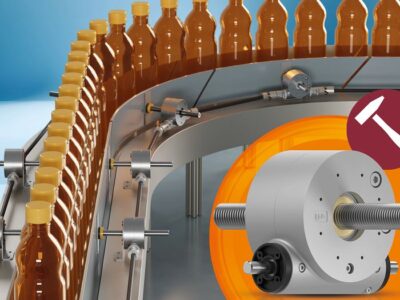
The switch from classic metal gearboxes to worm gear screw jacks made of high-performance plastic from the drygear Apiro series promises several advantages: reduced costs, lower weight and no need for lubrication. However, many design engineers were not able to make this transition because the operating environments were too harsh and demanding. With the drygear Apiro HD, igus is now presenting a hybrid solution that closes precisely this gap. The worm gear is still made of lubrication-free tribopolymers. A zinc die-casting housing provides the necessary robustness.
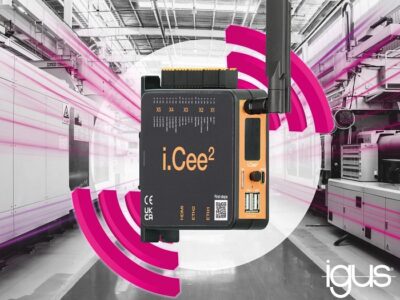
The industrial use of machine data is a key lever for greater efficiency, less downtime and more sustainable production. Nevertheless, the introduction of condition monitoring and predictive maintenance often fails in practice due to complex IT structures, high implementation costs and a lack of data transparency. With the new i.Cee² module, igus offers a solution: Companies can use the edge module to quickly and easily record, visualise and analyse initial machine data.
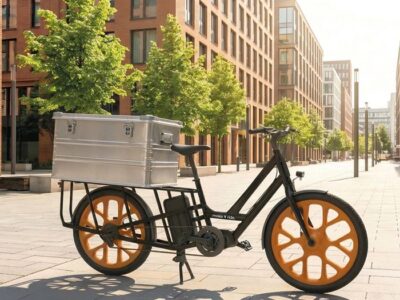
In more and more cities, food distributors are offering delivery to your doorstep by cargo bike. However, cargo bikes have a weak spot: their wheels bear higher loads than those of normal bicycles. As a result, defects occur time and again, resulting in delivery failures and expensive repair costs, making this means of transport less cost-effective. The solution from igus: robust wheels that are manufactured in one piece from plastic using rotational moulding.
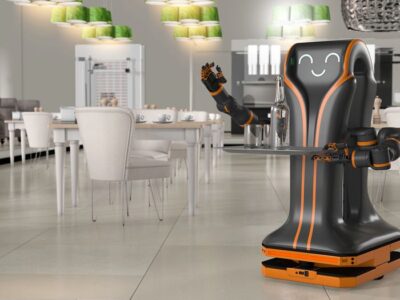
Humanoid robots are currently all the rage. They run marathons and dance the moonwalk to Michael Jackson. In practical industrial applications, however, their use fails mainly due to their costs. This is precisely where igus comes into play with its cost-effective humanoid Iggy Rob robots. Having already introduced the Iggy Rob Industrial for production environments in 2025, the company is now expanding the platform with a new variant: the Iggy Rob Home starting at €55,000. With the new model, igus is transferring the existing platform concept to the service and household sector for the first time. Development and production are carried out entirely in Germany – from mechanics to electronics to software.
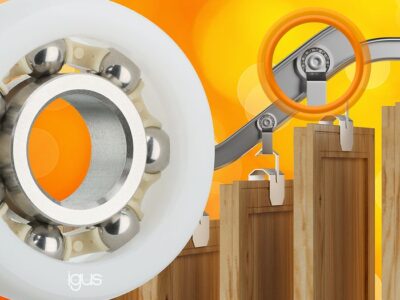
Dusty environments can become a problem for overhead conveyors in industry and logistics. When particles settle on conventional metal bearings, deposits cause sluggishness and, in the worst case, failure. To solve this problem, igus is launching a new hybrid ball bearing from the xiros series. Made of stainless steel and high-performance plastic, it allows for lubrication-free and therefore dirt-resistant operation with a load capacity of up to 39kg.
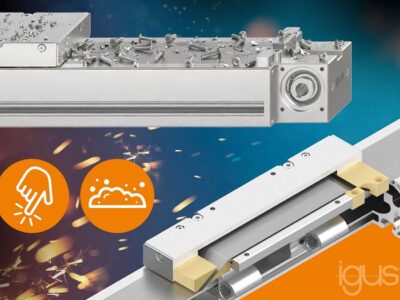
In production and automated systems, linear axes are exposed to various mechanical loads. Apart from coarse dirt, the small parts falling into the system pose a particular risk, for example during assembly or maintenance work. igus has developed the drylin linear axes ZLX-806016-PT and SLX-806016-PT, which prevent foreign objects from entering the axis and at the same time protect users against injuries. Thanks to a fully integrated metal cover, they are a completely closed and robust system, which is easy to assemble and reliably protects the guide, bearing and drive. They are suitable for workspaces, machine panelling or automation solutions, but also for applications in public areas where accessibility and trouble-free continuous operation are required.
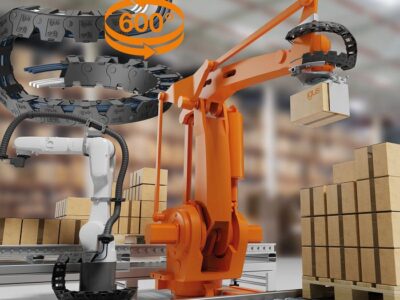
Compact industrial articulated arm robots still pose challenges for design engineers when it comes to energy supply. There are hardly any suitable solutions on the market that can cope with the fast rotational movements along the first axis and the limited space available. igus is now closing this gap with a new unsupported energy chain from the twisterchain series. This product also solves a second problem: the energy supply along the fifth axis of palletising robots. Here, too, many design engineers have been experimenting with their own solutions.
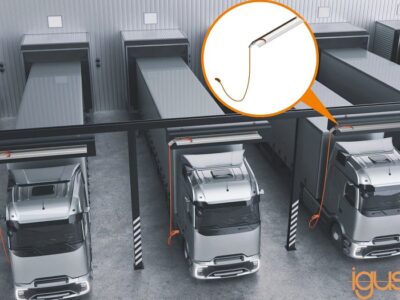
The number of e-lorries is increasing, and with it a problem in logistics centres, transhipment yards and bus depots: the heavy charging cables are often difficult for drivers to move. If they are on the ground, they are also at risk of being stolen or damaged in manoeuvring accidents. igus is therefore shifting cable guidance into the air: the new e-tract DC horizontal is an electric overhead cable guide system for electric lorries, coaches and buses that makes workplaces more ergonomic for drivers, reduces the risk of damage and downtime to the charging infrastructure and is difficult for thieves to reach. The AC version of the system will also be used for electric cars in underground car parks, for example.