igus sets the course for worldwide growth and fast delivery times – with investments in automation and local production
April 14, 2026
With global investments totalling €124.4 million, igus strengthens fast supply chains, customer proximity and competitiveness

At a time when global conflicts and economic uncertainty are slowing down many industries, the power to innovate remains essential for growth and competitiveness. With 227 new motion plastics products, igus proves that innovations can emerge precisely when conditions are difficult. To achieve further growth, the company has invested heavily in new infrastructure and automation, leading to even faster delivery times. In addition, igus is expanding its global activities with new and existing subsidiaries to further strengthen customer proximity through local production.
Despite global challenges, igus succeeded in growing its 2025 turnover to €1.155 billion – an increase of 4.4 percent compared to the previous year. The three largest sales markets for igus are China, Germany and the USA, which together account for around 60 percent of sales. igus employs 5,423 people across the globe – 185 more than in 2024, and 2,044 of them in Germany alone. To become independent of the external labour market by 2027, the company has set up its own Training Factory at its headquarters in Cologne at a cost of €600,000. In 2025, igus invested a total of €42.2 million in the innovation centre in Cologne alone and €11.5 million in shareholdings. In addition, €70.7 million were invested in the global subsidiaries. The funds are used for new land, buildings and modern tools, among other things, all with the aim to supply customers even faster and more reliably in future. “Product quality and price are no longer the only differentiating factors,” says Artur Peplinski, CEO and Spokesman of the Management Board at igus. “Our customers increasingly need suppliers who can deliver quickly and, above all, reliably without having to compromise on product quality.” One lever for more speed is automation. As part of the new “Phase 8” building at the Cologne headquarters, for example, a fully automated small-parts warehouse is being built, which will shorten the throughput of orders with up to 1,800 storage and retrieval operations per hour. Specially developed automation solutions that relieve employees of routine tasks, such as unloading injection-moulding machines, ensure additional speed in production. The 857 injection-moulding machines in Cologne produce over one billion components a year. In areas such as crimping and soldering, new automation solutions allow for throughput times that are up to 10 to 30 times faster than manual processes.
1,500 square metres of additional test space for more research and innovation
To guarantee high quality at all times, the industry’s largest test laboratory in the world has become even larger and now covers 5,500 square metres. “Adding 1,500 square metres to our test areas in the new building exclusively for our dry-tech products creates the basis for more capacity and new products, such as PTFE-free and bisphenol-free materials,” says Peplinski. “The number of test rigs alone has increased by around 20 percent and with it the number of tests: from the current 11,000 to a total of around 17,000 tests per year.” Part of the investment was also channelled into the development of new online tools that enable design engineers to configure products automatically, and therefore even more easily and quickly, without having to exchange design drawings with the igus sales department.
New subsidiaries and local production for even greater customer proximity
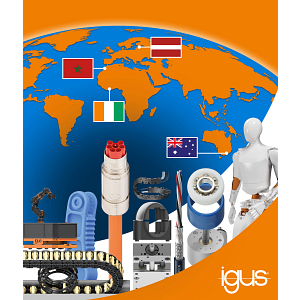
igus still manufactures around 95 percent of its components in Germany. However, the trend towards local production is increasing all over the world. Developments such as China first or America first are an expression of this reality. To better understand and meet local challenges and improve its own eco-balance, igus expanded its plants in China, the USA, Poland, Turkey and Japan in 2025. In many places, larger storage and assembly factories have emerged. “By expanding local production capacities in China and the USA alone, we lowered transport weight by around 1.2 million kg in 2025 – a significant contribution to CO₂ reduction,” emphasises Peplinski. The company has also established new subsidiaries in Australia, Morocco, the Ivory Coast and Latvia.
Sustainability remains a central component of the corporate strategy. Since 2025, igus’s production has been climate-neutral at its headquarters in Cologne in accordance with Scopes 1 and 2. The company’s own recycling platform chainge is also continuing to grow: 235 tonnes of disused energy chains have been taken back so far. “One important step forward is the new ISO-certified validation, which allows us to demonstrate the CO2 savings of our energy chain recycling to customers in a transparent way,” explains Peplinski.
227 new products allow for further growth
The new products from igus are also intended to ensure international growth and help the company break into new markets. The plastics specialist will be presenting a total of 227 new motion plastics products at Hannover Messe 2026. These include the first drylin C roller guide, 3D printing materials for the food and beverage industry and the e-spin energy supply system, a new cleanroom solution for long travels with ISO Class 1 certification from Fraunhofer IPA. This year, igus will also be presenting new solutions for e-mobility with e-tract AC and DC. igus sees low-cost robotics in particular as a growth driver. “It is our goal to democratise automation,” says Artur Peplinski. “Small and medium-sized companies with limited budgets and little previous experience should also benefit from the benefits automation offers.”
To this end, igus is expanding the RBTX online platform. The aim of igus is to develop the RBTX ecosystem further, turning it into a service hub for complete automation solutions. In future, RBTX will not only bundle components from over 260 well-known robotics manufacturers, but also connect users with suitable integration partners – quickly, transparently and independently of the manufacturer. Around 100 humanoid robot models from 35 manufacturers are already available today. Peplinski summarises: “We want to show that sustainable growth and technological innovation are possible even in challenging times. With a consistent focus on speed of delivery, local presence and automation solutions, we are setting the course for growth – for us and our customers.”