New overhead cable guide from igus improves the charging of e-lorries and e-cars
April 30, 2026
e-tract DC horizontal: more comfort for drivers, fewer manoeuvring accidents and maximum theft protection
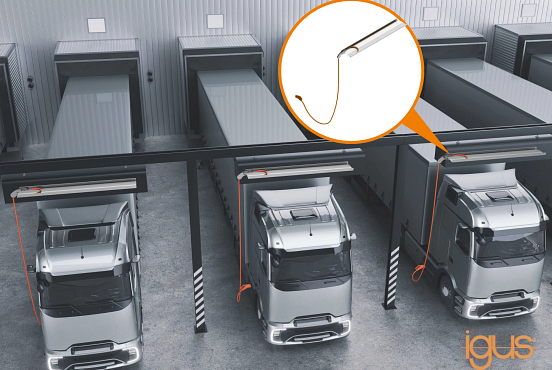
The number of e-lorries is increasing, and with it a problem in logistics centres, transhipment yards and bus depots: the heavy charging cables are often difficult for drivers to move. If they are on the ground, they are also at risk of being stolen or damaged in manoeuvring accidents. igus is therefore shifting cable guidance into the air: the new e-tract DC horizontal is an electric overhead cable guide system for electric lorries, coaches and buses that makes workplaces more ergonomic for drivers, reduces the risk of damage and downtime to the charging infrastructure and is difficult for thieves to reach. The AC version of the system will also be used for electric cars in underground car parks, for example.
e-tract DC horizontal consists of a guide trough that can be attached above the driver’s cab, either as a stand-alone unit or mounted on shaft end supports or hall structures. The power cable lies in the trough in a loop. One end is fixed for the power supply; the charging cable is moved safely on a conveyor belt. When the driver activates the system, the belt moves the cable forwards so that the charging plug is slowly lowered and can be connected to the vehicle. “The system is more fail-safe than floor solutions,” says Christoph Koch, Product Manager e-chains at igus. “The cables no longer drag on the floor, which reduces the risk of them wearing out and failing. In addition, there is no longer any danger of vehicles driving over the cable or colliding with the charging station.”
Automated charging system takes the strain off lorry drivers
Cables for so-called megawatt charging systems (MCS) with direct current are thicker and heavier than conventional cables for electric cars. They are designed for high power, require thick copper conductors and strong insulation, so that they weigh up to 4kg per metre. It can be exhausting for drivers to move these heavy cables. Pulling them out of a charging point is tedious and, in the worst case, can lead to physical strain. Lorry drivers in particular often describe high everyday stress levels which, according to studies, lead to above-average sick leave. “Thanks to the automated lowering, the heavy charging cables can now be connected to the vehicle without effort,” explains Koch. “This makes charging more ergonomic and attractive.”
Compact AC version for e-cars
The number of registered electric cars is also increasing worldwide. The charging infrastructure has to follow suit. However, space for charging stations on the ground or wallboxes is often limited, for example in multi-storey car parks. igus is therefore also launching the e-tract horizontal charging system in an AC version for alternating current. The guide troughs, which are significantly narrower than in the DC version, can be mounted directly above the parking spaces. The cables, which are also thinner, can be automatically moved towards the ground at the touch of a button so that drivers can conveniently connect them to the vehicle.
Overhead cable guide prevents theft
Charging stations that are located on the ground can be stolen. EnBW, one of the largest rapid-charging operators in Germany, is warning of an increase in thieves who are after the copper in the charging cables. In 2025, the company recorded charging cable theft in the range of 15 to 20 cables per day. The total cost per incident amounted to around €5,000 to 8,000. “As our overhead cable guide systems retract the cables outside of operating hours, it is much more difficult for thieves to reach them,” says Koch. Public charging yards, service stations, port logistics and underground car parks in particular could benefit from this.