
3D Printing
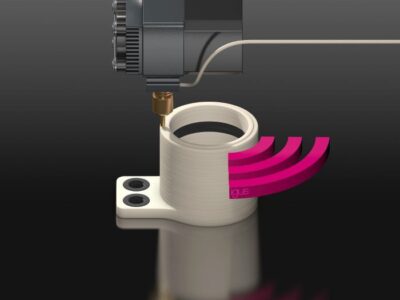
Even today, 3D printed wear-resistant parts from igus often have the same service life as original parts. Now igus goes one step further and makes the printed components intelligent. Manufactured in filament printing, they warn against overload and report their maintenance requirements. The special feature: for the first time, the sensors are directly “printed into” the parts. As a result, they not only have extremely short delivery times and low costs but also feature useful Industry 4.0 options.
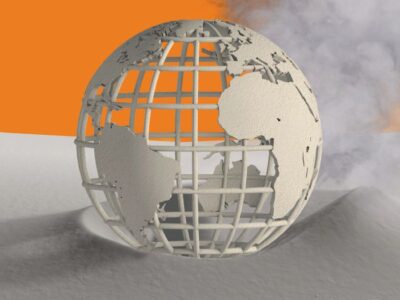
120,000 additively manufactured components were delivered by igus last year. Reason enough for the motion plastics specialist to further increase its capacities and equip its 3D printing service with new functions such as wall thickness and undercut analysis. In this way, customers worldwide can obtain their lubrication-free and low-maintenance components very easily and quickly, thereby saving costs.
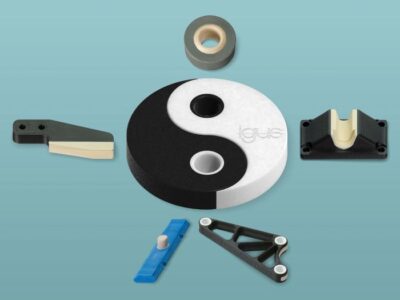
Prototypes, spare parts, tools and small batches: 3D printers of the Cologne-based plastics specialist igus now also produce components with various filaments. Different material properties can be easily combined in this 2-component 3D printing. For example, 3D printing can be used to produce components that require both special rigidity and high wear resistance. This gives companies more freedom and flexibility in design.
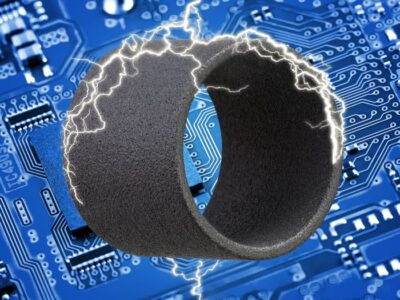
For safe and reliable production in the electronics and semiconductor industry, components are required that have electrostatically conductive properties. This is because even a small electric shock can destroy expensive production lines. igus has now developed a new stable material for the SLS method so that users can make their wearing parts with ESD properties flexibly and cost-effectively. The lubrication-free special parts made of iglidur I8-ESD can be printed and shipped within just few days.

At the moment, the protection of medical personnel is one of the most important challenges. However, a sufficient amount of appropriate equipment of the necessary quality, is not quickly available on the market. Solutions include face shields, which private persons and companies are currently making all over the world using 3D printing. igus has now applied itself to a central problem that such production is facing and is donating the first 100,000 head bands made with the injection moulding method.
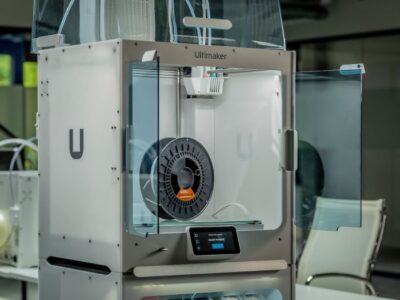
Due to the co-operation between Ultimaker and igus, the processing of the iglidur tribo-filaments in the Ultimaker 3D printers has become a lot easier. Neither special knowledge nor programming expertise is required to produce lubrication-free, low-wear components. The extensive material tests and the open source software “Cura” make this possible.
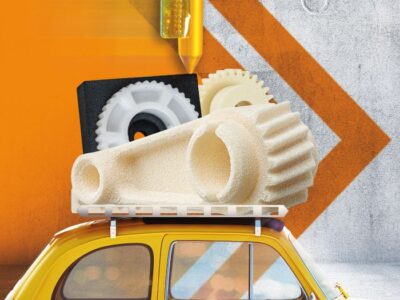
Additive manufacturing gives designers new freedom and flexibility in the design of special solutions, including the development of efficient vehicle components. If lightweight and durable wear-resistant parts are required, igus offers the right solution from its 3D printing service. Users can order their special part made of tribologically optimised polymers from igus online in just a few seconds. You can choose from over 55 lubrication-free iglidur materials.

In order to be able to quickly supply and install the right plain bearing solution at all times, igus keeps more than 12,000 different iglidur plain bearing types made of tribo-polymers in stock. But sometimes customers demand plastic components which are not in the catalogue.
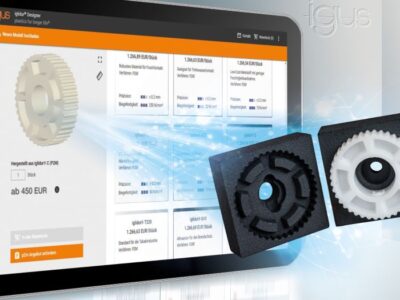
Injection moulding with 3D printing: 55 lubrication-free igus materials for individual wear-resistant parts
igus expands 3D printing service by injection moulding with printed tools for fast production of maintenance-free special parts.
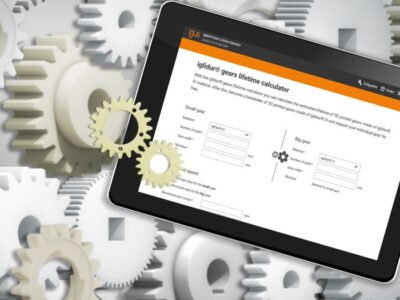
How long will my gear last? To answer this question, igus has now developed the gear service life calculator for its 3D-printed gears made of the laser sintering high-performance plastic iglidur I3. With the new online tool, the user receives a concrete statement in a few seconds about the service life of the wear-resistant part.