
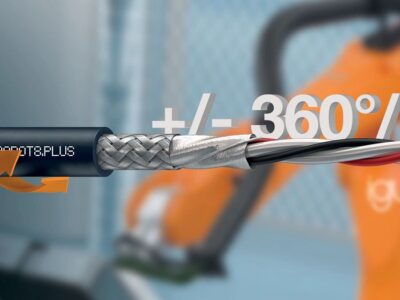
Today, industrial robots operate at ever higher speeds, with complex motion profiles and in increasingly confined spaces. Robot cables must not only allow for extremely small bend radii, but also reliably withstand millions of torsional movements. To meet these demanding requirements, igus has developed its proven CFROBOT8.PLUS range of robot cables and is now expanding it to include a new DeviceNet cable for applications involving ±360°/m torsion.
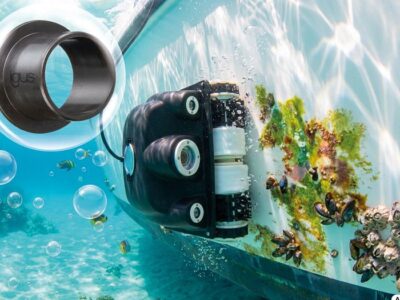
It is every boat owner’s nightmare: algae, mussels and barnacles that have to be removed from the hull before every season. In future, a remote-controlled diving robot named KeelCrab by the Italian company Aeffe will make the stowaways easier to remove. However, for the little crawler to work permanently underwater, the developers had to solve a challenge with the drive. The bearing of the drive rollers with lubrication-free polymer plain bearings from igus plays a key role.
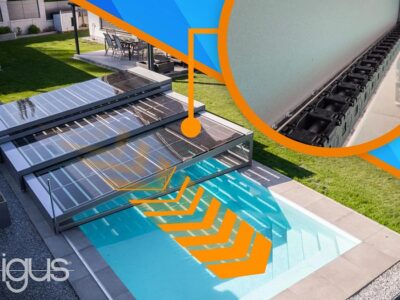
Anyone with a swimming pool in their garden will, in future, be able to use it not only for swimming in the summer, but also to generate electricity. The Austrian company SKYVOLUTION Energy GmbH has developed a retractable pool enclosure with integrated photovoltaic modules for this purpose. The system combines protection, design and sustainable energy generation in one solution. However, integrating the solar panels presented its challenges: the cables had to be guided through the moving structure in a very confined space and in an environment exposed to moisture and chlorine vapours. igus provided the ideal solution with compact and robust energy chains, including a version specially customised for this application.
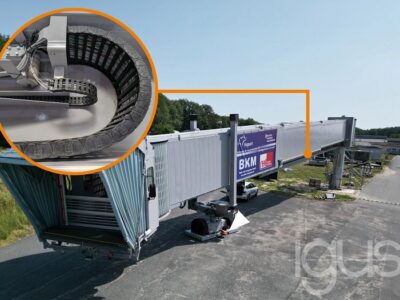
The train’s running late, the tickets have been left on the kitchen table, the child has forgotten its teddy: there are plenty of reasons for missing your flight. The factors at work behind the scenes of airport operations are less well-known: for example, automated passenger boarding bridges that transport passengers from the terminal to the aircraft. Here, a multitude of cables have to follow complex 3D movements whilst docking with the aircraft. A fault with one of the cables can delay the boarding process. To minimise this risk, the German company REEL relies on energy chains from igus.
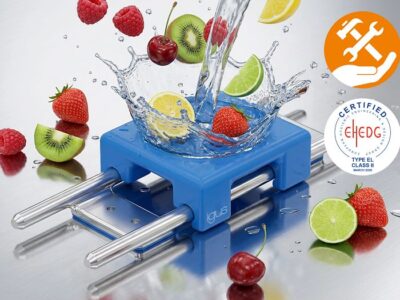
Easy cleaning of machines and systems is crucial in the food industry. However, the carriages of many linear guides are difficult to disassemble. To reduce downtime, igus has developed a new drylin W linear guide with a polymer carriage that can be removed for cleaning without tools. The system is the first linear guide in the world to receive EHEDG certification, giving it official approval for food technology.