igus wins business prize for sustainability
September 9, 2022
The Rhineland Business Prize honours the chainge recycling programme as an important step towards sustainable management
Many products are still incinerated when their service life is over. Valuable raw material is thus lost. Emissions pollute the environment. igus has therefore launched the chainge recycling programme for its plastic energy chains – an initiative for which the company has now received the Rhineland Business Prize in the sustainability category.
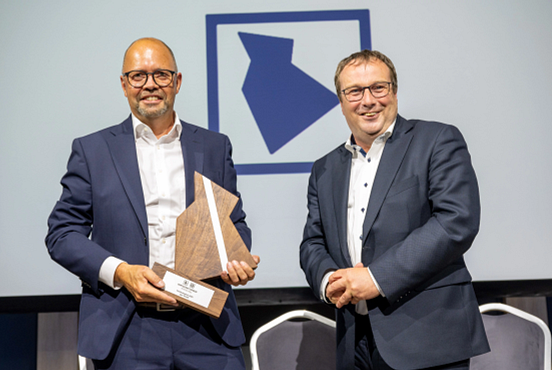
On the evening of 14th September, the suspense mounted aboard the MS RheinGalaxie in Cologne. As part of the first Wirtschaftsnacht Rheinland, the Kölner Stadtanzeiger had invited around 300 guests to the newest Cologne-Düsseldorf ship to present companies from the metropolitan region with the Rhineland Business Prize for exemplary smart economy management. In the sustainability category, igus impressed the panel of judges, consisting of personalities such as Nicole Grünewald, President of the Cologne Chamber of Commerce, and Thorsten Breitkopf, Kölner Stadtanzeiger Head of Economics, with its chainge programme. In his speech, NRW Minister for Environment Oliver Krischer, who presented the prize, praised the company’s commitment. The igus recycling programme saves energy chains made of high-performance plastics, which are used in many industrial machines and plants worldwide, from incineration, giving them a second life. Customers can send their worn-out energy chains to igus, even if they are energy chains from competitors. In return, customers receive a voucher based on the weight of the chains. That way, over 52 tons have been collected and recycled since 2019. But igus goes a step further: based on the chainge recycling programme, igus has now developed the world’s first energy chain made entirely of recycled material in order to conserve valuable resources and further advance the circular economy.
The leap from linear to circular economy
“We are very pleased to receive the Rhineland Business Prize. The award shows us once again that we are on the right track with our chainge recycling programme,” said Michael Blass, CEO e-chain Systems at igus. “Reprocessing energy chains constitutes a leap from a linear to a circular economy. This step improves products’ CO2 footprint and contributes to protecting resources and the environment.” igus develops and manufactures plastic energy chains for industry that are used in crane systems, train doors, packaging machines and robots to protect the cables within them. One focus of research is on extending service life. Over the years, advances in material composition and design have increased e-chain running performance to around 375,000 kilometres – roughly the distance from the earth to the moon. But at some point, even the best product will reach the end of its service life. What then? Most users remove the energy chains from their machines and throw them into industrial waste for incineration. The disadvantages of this linear economy are obvious: emissions damage the environment, and valuable raw material is lost forever.
“The chainge recycling programme is an important next step towards sustainable management”
It is more ecological for users to send worn-out energy chains back to igus. There, the company transforms them into granulate that injection-moulding machines can use to produce new energy chains. The E2.1.CG cradle chain is the first energy chain in the world made entirely of recycled material. It has the same technical specifications and load limits as new chains. “Recycling is nothing new for us. As the world’s biggest manufacturer of plastic energy chains, we already recycle 99% of the plastic waste from production in order to reuse it as regranulate,” says Blass. “The chainge programme is an important next step towards sustainable management.” chainge has already been rolled out in eight countries, with more to come.