First linear guide in the world to be EHEDG-certified for hygienic food technology
July 9, 2026
Tool-free disassembly for cleaning reduces maintenance effort and downtime
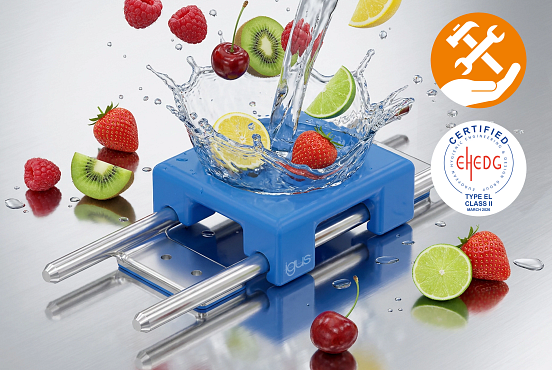
Easy cleaning of machines and systems is crucial in the food industry. However, the carriages of many linear guides are difficult to disassemble. To reduce downtime, igus has developed a new drylin W linear guide with a polymer carriage that can be removed for cleaning without tools. The system is the first linear guide in the world to receive EHEDG certification, giving it official approval for food technology.
Almost every designer of automation solutions for the food industry works with linear guides. For example, they enable the movement of sealing stations in thermoforming packaging machines, the positioning of dosing heads in filling systems and the guiding of knife units in bread slicers. Although indispensable, linear guides present a challenge in applications with stringent hygiene requirements. This is because lubricants, abrasion and dirt can accumulate in gaps, contact surfaces and hard-to-reach areas. “If thorough cleaning is required, dismantling classic systems is often complicated and structurally limited,” says Mira Loges, Development Engineer for drylin at igus. The demand is therefore for linear guides that are designed in accordance with hygiene requirements and can be cleaned quickly. “We have launched such a solution with the new drylin W linear guide, the first linear guide in the world to receive certification from the European Hygienic Engineering and Design Group (EHEDG).” The EHEDG is an international organisation that establishes standards for hygienic equipment design with the aim of enhancing food safety. An EHEDG certificate confirms that a component is easy, complete and safe to clean – an important advantage for operators with the highest demands on process and product safety. The certification confirms that the design of the drylin W linear guide system contributes to reducing the risk of contamination and equipment failures.
Quick and easy disassembly for shorter downtimes
Linear guides often make it difficult to clean machines and systems in the food industry. “Classic ball recirculation guides, for example, often have to be dismantled with tools and removed over the end of the rail,” says Mira Loges. “This leads to unnecessary maintenance work and downtime, which some users complain about.” igus has therefore designed the new linear guide in such a way that it can be dismantled without tools. The system consists of two stainless steel shafts and a monolithic polymer sliding carriage onto which users can bolt their structures. “In the event of a complete system cleaning, the carriage can simply be pulled off the rail and cleaned separately. The rail can be cleaned in place without disassembly,” explains Mira Loges.
Lubrication-free hygienic design reduces the risk of contamination
Many conventional ball recirculation guides work with lubricants to which dust, abrasion and dirt particles can adhere. This can create an abrasive mixture that impairs ease of movement and represents a potential risk of contamination. igus has therefore consistently designed the new linear guide in accordance with EHEDG guidelines. The electropolished round shafts have a surface roughness of less than 0.8 micrometres, which facilitates effective cleaning as germs and product residues hardly adhere to the smooth surface. “We consistently followed the EHEDG guidelines during development. One challenge was the transition from the shafts to the shaft supports or rail connectors. But even here we managed to follow the guidelines. The transitions are milled so that minimum radii of three millimetres could be maintained everywhere,” explains Mira Loges. A floor seal made of FDA-certified silicone also ensures that no dirt or micro-organisms can accumulate between the rail and the surface.
Another notable feature is the carriage made of the blue high-performance polymer iglidur A160. It is PTFE-free and PFAS-tested, and integrated, microscopic solid lubricants ensure an exceptionally hygienic, lubrication-free dry operation. “We also made sure that the material has low total moisture absorption. This means the carriage retains its shape and functionality even after many intensive cleaning cycles.”