3D printer builds houses from clay
February 20, 2026
Lubrication-free polymer liners from igus make 3D printers from Italian company WASP more fail-safe
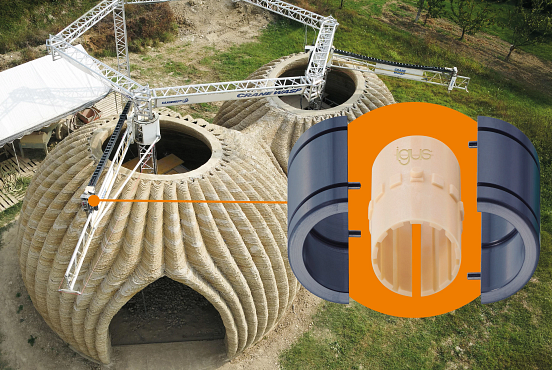
Creating affordable living space in off-grid regions: this is possible thanks to a large-format 3D printer from the Italian company WASP, which uses clay to build house walls. To ensure that the printer can carry out this work reliably and without constant service and despite high dust and dirt loads, the engineers rely on lubrication-free liners made of high-performance plastic from igus in the machine’s mechanics.
Potter wasps can build their own home from natural materials that they collect in the environment. The Italian company WASP has used this mechanism to develop the modular 3D printer Crane WASP, which builds house walls from clay on construction sites. This way, for example, the TECLA house in Massa Lombarda, Italy, was created. It is the world’s first 3D-printed, dome-shaped building made entirely of a mixture of earth and water. The aim of WASP is to offer a technological solution that makes it possible to create living space in off-grid regions in a cost-effective, environmentally friendly and fast way. With Crane WASP, houses can be constructed from locally sourced, natural materials, agricultural waste and standardised building materials.
Too much dirt and dust for conventional metal bearings
The 3D printer consists of a main printer unit that can be assembled in various configurations. The printing area of a single unit has a diameter of 8.2 metres and a height of 3.2 metres. The Crane WASP has a vertical mast and a height-adjustable boom that can be swivelled through 360 degrees. A clay extruder travels horizontally on the boom, erecting the walls of the building layer by layer. This process took 200 hours at TECLA house. A project of this size means a considerable load for the components of the 3D printer. The bearing points, where the print head moves on the Z-boom for hours on end and which are constantly exposed to dust and dirt, are particularly stressed. The WASP team recognised the risk that these particles could destroy the lubricating film in metal bearings, cause mechanical abrasion and increase friction and wear. At worst, this could lead to a bearing failure. For this reason, WASP was looking for a dirt-resistant alternative to conventional metal bearings.
3D printers more economical thanks to lubrication-free liners from igus
The team opted for drylin R JUM-01-50 liners made of the high-performance plastic iglidur J. The carriage with the print head slides over these liners on the aluminium struts of the boom. The special feature: no lubricating grease is required as igus integrates solid lubricants into the high-performance plastic, which are released during operation and allow for dry operation over years. Thanks to the igus liners, the mechanics of the 3D printer are not only more resistant to dirt and more fail-safe. Lubrication work is also no longer necessary. This eliminates time-consuming maintenance work and reduces operating costs in daily use. Another advantage of the liners made of high-performance plastic is that they are up to 80% lighter than comparable metal bearings. According to WASP, their lower mass improves the precision and reaction speed of the print head and thus the print quality. The design engineers do not have to make any compromises in terms of robustness. The liners are designed in such a way that they can absorb both lateral and axial loads when the print head moves. They are also resistant to moisture and temperature fluctuations. These specifications ensure that the 3D printer works reliably even under difficult conditions.